
Donny Dough
 Sam Nicholson
Donny Dough makes exactly the promise its name suggests: a self-satisfied money man in a top hat, surrounded by gold, multipliers, and the unmistakable energy of a game that knows it’s selling a fantasy. The question worth asking — and the one most reviews of this type skip entirely — is whether the math underneath justifies the showmanship on top.
The headline here is LOOTLINES™, a proprietary payline mechanic that treats multiplier symbols as the building blocks of wins rather than mere boosters. It’s not a reskin concept, and it’s not borrowed from a competitor’s blueprint. Whether the execution lives up to the concept is what this review is for.
LOOTLINES™ — What It Actually Does
The core of Donny Dough is a 5-reel, 4-row grid with 14 paylines, and the game lives or dies on how well LOOTLINES™ works in practice.
Multi-Dough symbols — Donny’s grinning head rendered on a round body, wearing the obligatory hat — can land in four distinct forms. Adding versions carry values of 1x through 10x. Multiplying versions carry x2 through x5. Each type also has a Revealing variant that lands face-down with a question mark and flips to disclose a higher value: adding Revealing symbols reach up to 500x; multiplying Revealing symbols push to x25.
When a winning payline consists entirely of Multi-Dough symbols, the game resolves the values left to right. Multiplying symbols that sit first on a payline — before any adding symbol — are treated as adders, which prevents the math from spiralling in a way the paytable can’t support. The example in the rules makes this concrete: x3, 4x, 1x, x2 across a payline produces (3+4+1)×2 = 16x the bet. That’s not a typo. That’s the mechanic working as intended.
It’s a genuinely interesting piece of design — the kind where reading the rules twice is actually worth your time. The payout is not determined by symbol value alone but by the specific combination and sequence across the winning line. That means two players can land the same symbols and see meaningfully different results depending on position. For a payline game, that’s unusual.
Bonus Features
Sticky Dough Bonus
The lower of the two bonus modes triggers with 3 scatter symbols and awards 10 free spins. The key mechanic shift: Multi-Dough symbols become sticky, staying on the grid until they contribute to a winning payline and are then removed on the following spin. Landing additional scatters during the feature adds 2 extra spins for 2 symbols and 4 extra spins for 3 symbols.
In practical terms, Sticky Dough creates a building dynamic where the multiplier infrastructure accumulates across spins. The risk is that sticky symbols sitting outside of winning paylines are effectively dead — they’re visible, they look promising, and they contribute nothing until the right adjacent symbols arrive. That tension is either the feature’s appeal or its frustration, depending on what you’re looking for in a bonus round.
Strike Gold Bonus
The stronger mode triggers with 4 scatter symbols — also 10 free spins as the base — and runs on a fundamentally different logic. Winning paylines involving Multi-Dough symbols light up a bulb above each contributing reel. Up to 4 bulbs can be active simultaneously.
When Donny’s Hat symbol lands, it triggers a re-spin: each lit reel spawns a number of Multi-Dough symbols equal to its active bulb count at random positions, potentially chaining into further wins. Critically, a Donny’s Hat symbol is guaranteed on the final spin of the feature — so the last spin always carries the re-spin mechanic, whatever state the board is in at that point. That’s a meaningful design decision. It means Strike Gold never ends without one last swing.
The re-spin logic creates genuine escalation. Unlike Sticky Dough, where value accumulates gradually, Strike Gold can spike — a board that builds light bulbs across multiple reels over several spins, then resolves in a single Hat-triggered re-spin, can produce the kind of swing that defines a session. It’s the higher-variance of the two modes, and it plays that way.
Bonus Buy Options
Four tiers, clearly priced:
- BonusHunt FeatureSpins™ — 5× more likely to trigger either bonus. Cost: 3x bet
- Ka-ching FeatureSpins™ — Guarantees at least 5 Multi-Dough symbols on every spin. Cost: 50x bet
- Sticky Dough direct access. Cost: 90x bet
- Strike Gold direct access. Cost: 200x bet
The Ka-ching option is the one worth examining. Guaranteed Multi-Dough coverage on every base-game spin at 50x the bet effectively turns the base game into a LOOTLINES™ showcase — every spin has the ingredient structure needed for the mechanic to fire. Whether that’s value depends entirely on the hit frequency of winning paylines from those symbols, which is where the undisclosed volatility data becomes relevant.
What the Game Actually Looks Like
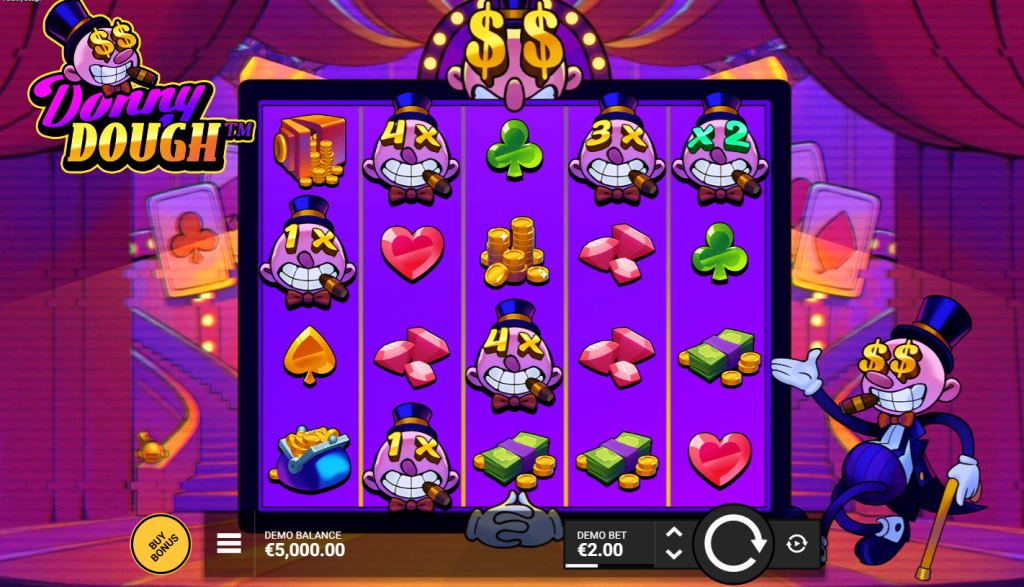
The visual approach is brash and deliberate. The 5×4 grid sits on a purple field — saturated, high-contrast, designed to make the multiplier values on the Multi-Dough symbols readable at speed. And they are: the 1x, 2x, 3x, 4x values are large, clearly coloured in yellow-gold, and visually distinct from the low-value card suit symbols — pink hearts, green clubs, gold spades, pink chevrons that read as arrows at a glance.
The high-value symbol set includes a stack of orange-spined books topped with gold coins, a blue treasure chest, and stacks of green cash notes — clean, chunky shapes that scale well on the grid. The card suits are functional rather than distinguished. They do the job.
Donny himself stands to the right of the reels: blue suit, dollar-sign eyes, cigar, bow tie, top hat branded $$. He’s a Monopoly man riff executed with cartoon confidence. The background — warm pink theatre drapes, a staircase suggesting a casino floor — creates atmosphere without competing with the reels. The composition works.
One visual inconsistency worth noting: the pink chevron symbols (which appear to represent diamonds in the card-suit set) read as directional arrows rather than gems at a quick glance. In a game where tracking symbol positions across 14 paylines matters, anything that slows identification is a small but real friction.
The Honest Drawback
Two things I’d flag before you commit a session to this game.
First: the Sticky Dough mechanic has a genuine dead-weight problem. Sticky symbols positioned outside of reachable paylines generate session-long tension with no release. That’s fine if you’re comfortable with extended dry stretches inside a bonus feature — frustrating if you’re not.
Second: the 200x buy price for Strike Gold is among the higher direct-access entry points in this format. Whether that’s justified depends on the max win ceiling and the volatility profile — information that should be checked in the paytable before committing.
Who Should Play Donny Dough
Play this if you want a mechanic that rewards reading the rules. LOOTLINES™ is not intuitive on first contact — the left-to-right value resolution and the multiplier/adder distinction require a moment of attention. Players who engage with the math will find the feature more interesting than most. Strike Gold, specifically, is a bonus round with a credible escalation structure.
Skip this if you want a bonus feature that feels consistently rewarding throughout. Sticky Dough in particular can be an exercise in patience — and players who judge a bonus round by the experience of being inside it, rather than the final result, may find it unrewarding.
Verdict
Donny Dough has a mechanic worth knowing about. LOOTLINES™ is genuinely novel in how it constructs payline wins from multiplier sequences rather than tacking multipliers on top of standard payouts. Strike Gold is the stronger of the two bonus modes and delivers the escalation the concept promises. Sticky Dough is the more cautious entry point, and its dead-weight risk is real.
The game’s showmanship — Donny’s grin, the theatre staging, the $$-branded hat — is exactly what it looks like: a presentation layer on top of math that can justify the confidence, if the RTP and volatility figures at your specific casino match the paytable’s top-tier settings. Check them before you spin.
FAQ
Donny Dough is a 5×4 payline slot built around the LOOTLINES™ mechanic, where winning paylines are constructed entirely from Multi-Dough multiplier symbols. It features 14 paylines, two distinct free spins bonus modes, and four bonus buy options.
Multi-Dough symbols land with adding or multiplying values. When a winning payline consists of these symbols, their values are resolved left to right — adding values stack, multiplying values amplify the total. A payline of x3, 4x, 1x, x2 produces (3+4+1)×2 = 16x the bet. The position of each symbol on the line materially affects the result.
Sticky Dough (triggered by 3 scatters) keeps Multi-Dough symbols sticky until they form a winning payline. Strike Gold (triggered by 4 scatters) lights bulbs above contributing reels and triggers re-spins via Donny’s Hat symbol, with one Hat guaranteed on the final spin.
Revealing adding symbols can disclose up to 500x; Revealing multiplying symbols can disclose up to x25. These are the ceiling values — they combine across a payline according to the LOOTLINES™ left-to-right resolution logic.
Direct access to Sticky Dough costs 90x your bet; Strike Gold costs 200x. The Ka-ching FeatureSpins™ option — which guarantees at least 5 Multi-Dough symbols per spin in the base game — costs 50x. BonusHunt FeatureSpins™ (5× bonus trigger rate) costs 3x.
